

Finding Balance: The Importance of Stability in Life
Discovering the Right Tools for Finding Balance
I’m in elementary school, working on a science project that will demonstrate my freshly acquired knowledge about levers and pulleys: a hoist-up-and-down kitchen bucket inside a homemade well for my American Girl doll. I already have a tin can to serve as my well, an old cylindrical Folgers container from the coffee that my dad, a salesman, burned through in no time between routine meetings and domestic travel. I walk outside in the Texas heat, the white-patterned concrete below me reflecting the glow of our warm-yellow porch lights, and I find a twig that I snap to the just-right length. I set the stick between two popsicle sticks that rest on opposite walls of the can.
However, I’m still missing a critical piece. The beige string from my craft box rests to the side, but I need a crank, something I can turn in order to wind the string around the stick. I search in kitchen draws and cabinets, but no luck. Finally, my search leads me to our living room, and I rummage through the drawer next to my dad’s regal grandfather clock. That’s where I find it: a polished wooden crank with a glimmering golden extension. It’s perfect. I run back to the kitchen and begin attaching the string to both the bucket and the crank, ready to wind it around the stick and see my well through to completion. Perhaps I’ll even put some water in it to see if I can earn bonus points for functionality.
My strategic dream of scientific superiority comes to an abrupt halt when my dad walks into the kitchen.
“Ashlee, what are you doing?”
“My science project, Dad.”
“Not with the crank to my grandfather clock, you’re not.”
“This is a crank to your grandfather clock?”
“Not just a crank, but the crank. You insert it into the holes on the dial, and it winds the three weights to keep the clock ticking.”
Well, shoot. The tool I thought I was using to further my creative thinking had inadvertently turned me into a petty thief.
The Role of Stability in Life: Lessons from Blondin, the Tightrope Walker
One of the best funambulists (the term for tightrope walkers) of all time was Jean François Gravelet, nicknamed “Blondin.” According to an article in the December 2, 2016 New York Times, he began self-training in the art of tightrope walking at age four, using his father’s fishing rod as his pole. Eventually, Blondin became the first person to tightrope walk across the gorge below Niagara Falls, and he repeated that same act seventeen times. The book, Confessions of an Amateur Rightrope Walker explains, “He crossed blindfolded, he crossed on stilts and he crossed with his manager on his back. Once he carried a stove, stopped at the midpoint and cooked himself an omelette.”
But Blondin didn’t start with a stove. The pole keeps a tightrope walker steady and sure, certain of their footing. When it comes to finding our way and refining new skills across tricky terrain, we would do well not to start with a stove (or someone else’s indispensable clock crank)—that situation you can’t quite put your words around or maneuver with a certain level of confidence. It may seem like a good idea right now (points for creativity!), but in reality, that situation belongs to someone else who can carry the weight more wisely. If you’re just learning how to tightrope walk, you need to find a pole that fits. Something that fits you is likely already in your vicinity and well within your reach. It’s a skill or gift you have that may seem easy for you to hold before you on display, even if you’ve been tempted to compare it to someone else’s. It’s an area of expertise, a hard-won respectability. It’s the strength of a safe relationship, the compassion of community. The right fit will emerge from the fabric of your gifts and not exploit your brokenness. If you are longing to enter into hard topics and flammable conversations with any level of confidence, find courage in knowing you already have some tools at hand. You’re going to have to discern what specifically keeps you steady and stable when the wind picks up and the wire starts swaying.
We might find balance with a family member or friend we admire, someone who will love us well and reassure us when stuff gets rough. Maybe we’re steadied through a passion or career we’ve given healthy energy to, or a group of friendships we’ve worked hard to nurture and that we’ve allowed to nurture us in return.
Staying Grounded in Faith: A Source of Stability
For me, my faith provides that centering point. My faith is not a religion or an object that I tangibly hold as much as it is a gift of a good foundation, solid ground where I choose to reorient myself.
The ground I choose to stand on at the end of the day, the reality that steadies me in disruption and uncertainty, is the faithfulness of the One in whom I put my trust.
Whatever your balancing apparatus, you have to be able to trust it to be a constant. Whatever helps you stay centered and steady won’t necessarily be what steadies your neighbor, sister, or significant other—it has to fit you. It may be bigger than you, but it cannot overwhelm you. It cannot shake or break or become flimsy when the stakes are highest.
That apparatus, then, cannot be your iPhone or Android or Blackberry (assuming some of us still use those). It cannot be programmed for planned obsolescence or trick you into shame spirals. Your stabilizing force cannot suck you into unfocused mindlessness or be part of your unhealthy escape, whether that escape be through a screen or through the pages of a book. Whatever steadies you—faith in God, love for family, or pursuit of future goals and dreams—needs to be constant, tried and true.
Part of fine-tuning how we say good must be finding what supports us, what can help us find our feet again when we inevitably stumble or fall flat on our rear. When our ego is bruised and feelings are hurt, we’ve got to know what centers us and holds us upright, an aid we don’t mind holding close, right in front of us, parallel to the very plane of our heart.
Conclusion: Embracing Stability for a Balanced Life
When you find a pole that fits, one that won’t waver, you’ll be bolstered even when you’re exhausted from the grueling fight to say the good thing. You’ll find the grace to begin again when you’re worn and tired; inspired to keep going, even when the journey across breaking news seems darker and more narrow. You’ll be strengthened to figure out the good you want to say or the silence you need to keep. When you’re steady, you may sense fear up ahead, but it’s hazy, small, and harmless. What’s close and more discernable is courage.
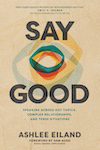
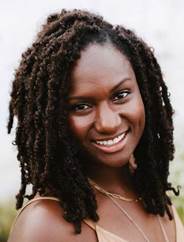 Ashlee Eiland is a thought leader, writer, and Bible teacher who exists to join in God’s redemptive work on earth. Her work has one purpose: to help humanity build bridges back to the truth of who God is and between one another in whole and healing relationships. Ashlee is vice president of partnerships for The Colossian Forum, a non-profit that works to harness the power of disagreement to restore connection. She formerly served as co-lead pastor at Mars Hill Bible Church in West Michigan. She and her husband live in Grand Rapids with their three kids.
Taken from Say Good: Speaking across Hot Topics, Complex Relationships, and Tense Situations by Ashlee Eiland. Copyright © 2023. Used by permission of NavPress. All rights reserved. Represented by Tyndale House Publishers, Inc.