

There is no question that our culture is changing, and many have noticed the similarities between our modern world and the ancient pagan one. In my new book: Cultural Sanctification: Engaging the world like the early church, I consider these connections and explore how the early church responded. We find early examples of this response in Paul’s engagement with various philosophical and political authorities (e.g. Acts 17 and Acts 24). The early church continued the same kind of engagement as they lived, worked, served, and ultimately transformed the ancient world. The excerpt below is from the introduction of the book where I define early Christian cultural engagement as “cultural sanctification,” and show how the early church navigated between their identity citizens in the present age and pilgrims on a journey toward a kingdom that is to come.
Early Christian Cultural Engagement in History
Anyone interested in ancient history knows that the struggle between Christianity and paganism was not easily decided. The problem was that pagan worship of the gods was integral to “an entire social world into which Christianity could not be fitted.” The encounter between paganism and Christianity was not some casual friendly afternoon collegiate debate; it was “at bottom a conflict between two religious visions” and took many years and much sacrifice to settle.
Addressing Modern Cultural Shifts
There are many voices [today] trying to chart a pathway through these murky waters. Most of the responses fall along two opposing lines: isolation or confrontation. The Reformed theologian John Bolt captures this sentiment when he asks whether Christians today should “acknowledge and more or less accept this changed state of affairs, or do we fight it?” As we stand watching the death of Christendom and the loss of cultural power, should we dig in our heels, grit our teeth, shout a war cry, and charge forward to confront the culture? Or should we cut our losses, fall back into safe position, and create isolated communities of resistance? …What is left is a sense of division and conflict built on two conflicting assumptions: the tendency to assimilate to the culture or to withdraw to the safety of a confined community. Missiology is indeed to the point: in our post-Christian age, we are all de facto missionaries living among the modern pagans in our neighborhoods, towns, cities, and states, pulled between calls to retreat and calls to confront. Neither option is entirely wrong, and perhaps in specific places and times, the church should gravitate more toward one or the other. But there is another option that neither repeats Benedict nor crowns Charlemagne. If we are living in a world of modern paganism, perhaps we should go back to the earliest centuries and examine the lives of the Christians who thrived in the age of the Caesars.
The Divided Approach to Cultural Engagement
When we come to the Christian sources of the earliest days of the church, we do not find the kind of frantic bifurcation found in much of the literature [today]. Instead, we find serious commitments to Christian identity and the distinctiveness of Christian doctrine and practice alongside discussions of good citizenship and public engagement that helped Christians navigate a pagan world. In essence, early Christian cultural engagement was defined not by an isolation or confrontation but by what we might call a “cultural sanctification.” Cultural sanctification recognizes that Christians are necessarily embedded within their culture and must seek sanctification (both personal and corporate) in a way that draws upon the forms and features of their environment to transform them by pursuing virtue. This Christian performance of sanctification involves defending the faith, sharing the good news of salvation found in Christ, and visibly embodying all the virtues of the Christian spirituality in ways that persuade others.
Principles of Indigenization and Pilgrimage
In his work on the history of missiology, the famous missiologist Andrew Walls argues that the church has always struggled between two opposing principles: indigenization and pilgrimage. The indigenizing principle, which emphasizes a localism, recognizes that when people convert to Christianity, they do not come as static, isolated individuals but as persons intimately bound to a social world. Conversion does not mean they cease to perform the normative human functions required to live: they drive cars, eat fast food, and enjoy an evening stroll through the woods. “In Christ,” Walls writes, “God accepts us together with our group relations; with that cultural conditioning that makes us feel at home in one part of human society and less at home in another.” Christians must always endeavor “to live as a Christian and yet as a member of one’s own society” and to make the church like a place where we feel at home in this world. In these ways, the indigenizing principle stresses the importance of a locally constituted community of faith walking and working together.
The Pilgrim Principle in Early Christian Cultural Engagement
However, in all their indigenizing efforts, Christians are always pilgrims and never fully at home in this world. The pilgrim principle “whispers to him [the Christian] that he has no abiding city and warns him that to be faithful to Christ will put him out of step with his society; for that society never existed, in East or West, ancient time or modern, which could absorb the word of Christ painlessly into its system.” Christian assumptions will always help guide the Christian life within the culture, but they will never be fully immersed in its patterns and practices. As Rowan Greer observes, “it looks as though the church is healthiest when the tensions are preserved—so that the Christian lives both in this world and in the light of the next and seeks to preserve both the holiness and the catholicity of the Church.”
Uniting Indigenization and Pilgrimage in Cultural Sanctification
Vince Bantu unites both of Walls’s indigenizing and pilgrim principles under the heading of “cultural sanctification” and suggests that the “gospel simultaneously indigenizes itself to the local culture and reminds the church that she is a pilgrim in this world and must be out of step with the culture where it conflicts with the call of following Jesus.” In my estimation, the concept of cultural sanctification, with its indigenizing and pilgrim principles, captures the way early Christians approached the pagan world. They always tried to guard “the newness of the message without isolating themselves from the culture or accommodating themselves to the culture.” Far from rejecting or confronting the world, the early church held these two principles together. While we might fear the dramatic cultural shifts of our time, we can draw assurance from the church having been here before. Through the steady process of cultural sanctification, the early church navigated the Scylla and Charybdis of cultural engagement.
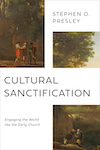
Excerpt of Cultural Sanctification: Engaging the World like the Early Church for Public Discourse
Stephen O. Presley
Excerpted from Cultural Sanctification: Engaging the World like the Early Church by Stephen O. Presley ©2024 (Wm. B. Eerdmans Publishing Co.). Reprinted by permission of the publisher.